
Do you FEEL alone?
Have you felt isolated now, or in the past?
Do you know someone who seems to be getting further out of reach the more you try to engage?
We're diving into one of the most pressing issues of our time: LONELINESS.
This topic is personal for me.
After moving to Atlanta in 2005 from Arizona, I was in over my head.
Getting married, moving across the country, living away from every support system we had, while crashing into a variety of toxic environments, it was rough.
As someone naturally inclined to build relationships, in the challenges and chaos of life, I FELT ALONE.
And, as a result, I drifted into a state of isolated survivalism. Unfortunately, as I share in the video below, my online activities attracted the wrong type of attention.
Not only was I vulnerable, but that vulnerability was exploited by other broken people, and that further complicated matters.
Life unraveled for me, but thankfully, after hitting my rock bottom, I was humbled and helped.
And this transformative experience informed the articulation and clarity of my vision: thriving together; the opposite of isolated survivalism.
I've been alone, and I've come out on the other side. And I want to help others navigate that same journey. So, what follows is a deep dive into the issue of loneliness.
We'll talk first about what this crisis is, and then we will explore its complex causes and some antidotes to the problem.
But first, let's begin by exploring the problem.
Defining the Crisis of Loneliness
So, what is the difference between Isolation & Loneliness?
My friend and narrative coach Jim Karwisch, in the video below, defines loneliness as a feeling of disconnection, where isolation is a physical state.
- Isolation is the physical absence of others. Jim shares the example of Tom Hanks in Cast Away to illustrate this idea.
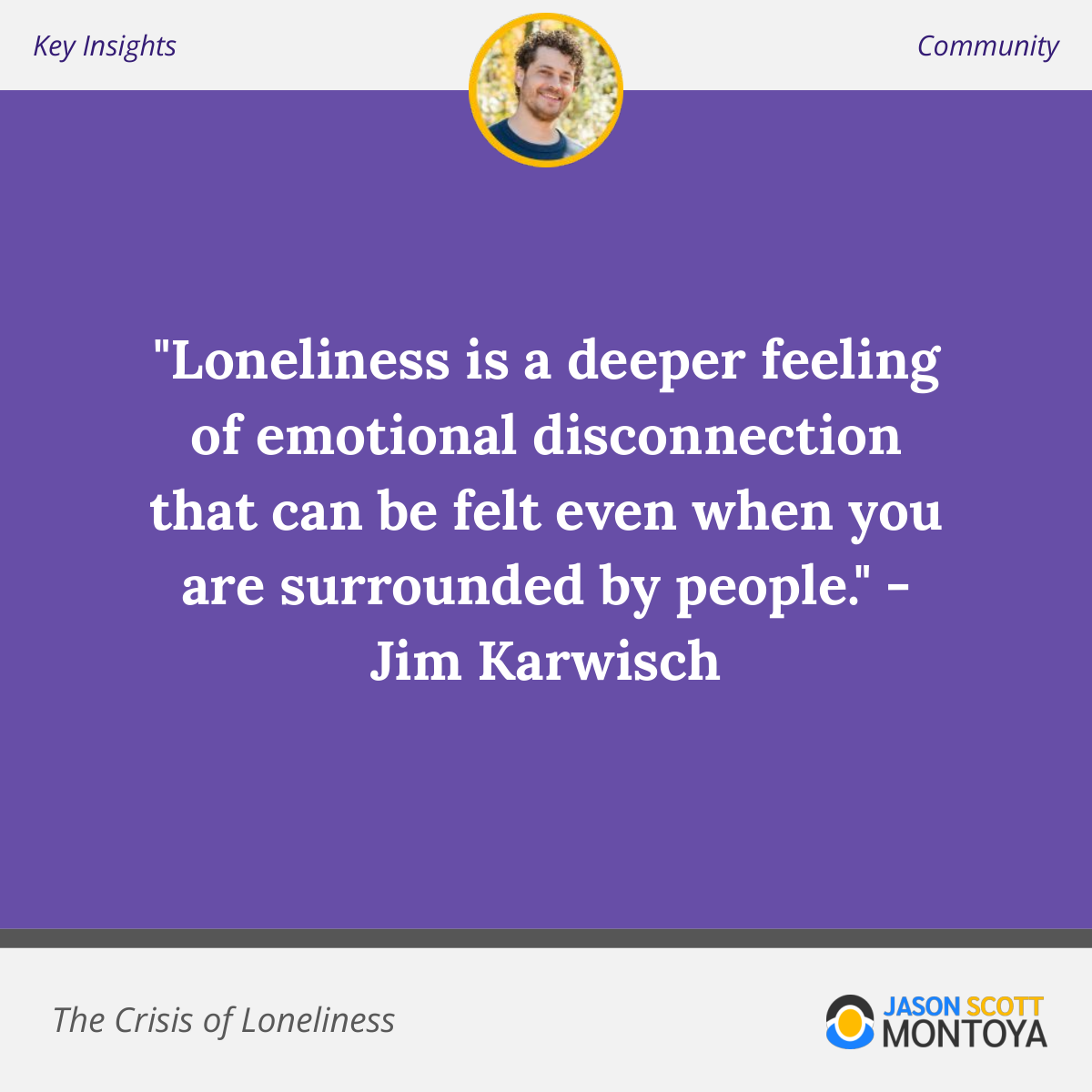
- According to Jim, Loneliness is a deeper feeling of emotional disconnection that can be felt even when you are surrounded by people.
Jim breaks down the idea into the following three parts.
- Physical isolation from others.
- Emotional disconnection, where you are around people but don't feel a strong bond with them.
- Ideological isolation, where you feel you cannot be authentic or speak openly due to a polarized social climate.
Jim proceeds to give an example of feeling lonely when a spouse is out of town. Although he is not physically isolated, he feels disconnected from a specific person with whom he shares a deep bond.
And on the ideological front, in a highly polarized country, we can feel timid about sharing our perspective on hot topic issues out of fear of alienation or how we earn our living. So, this issue of loneliness has reached epic proportions at the societal level.
The Societal Crisis
In the following video clip, Jim mentions the "public health crisis."
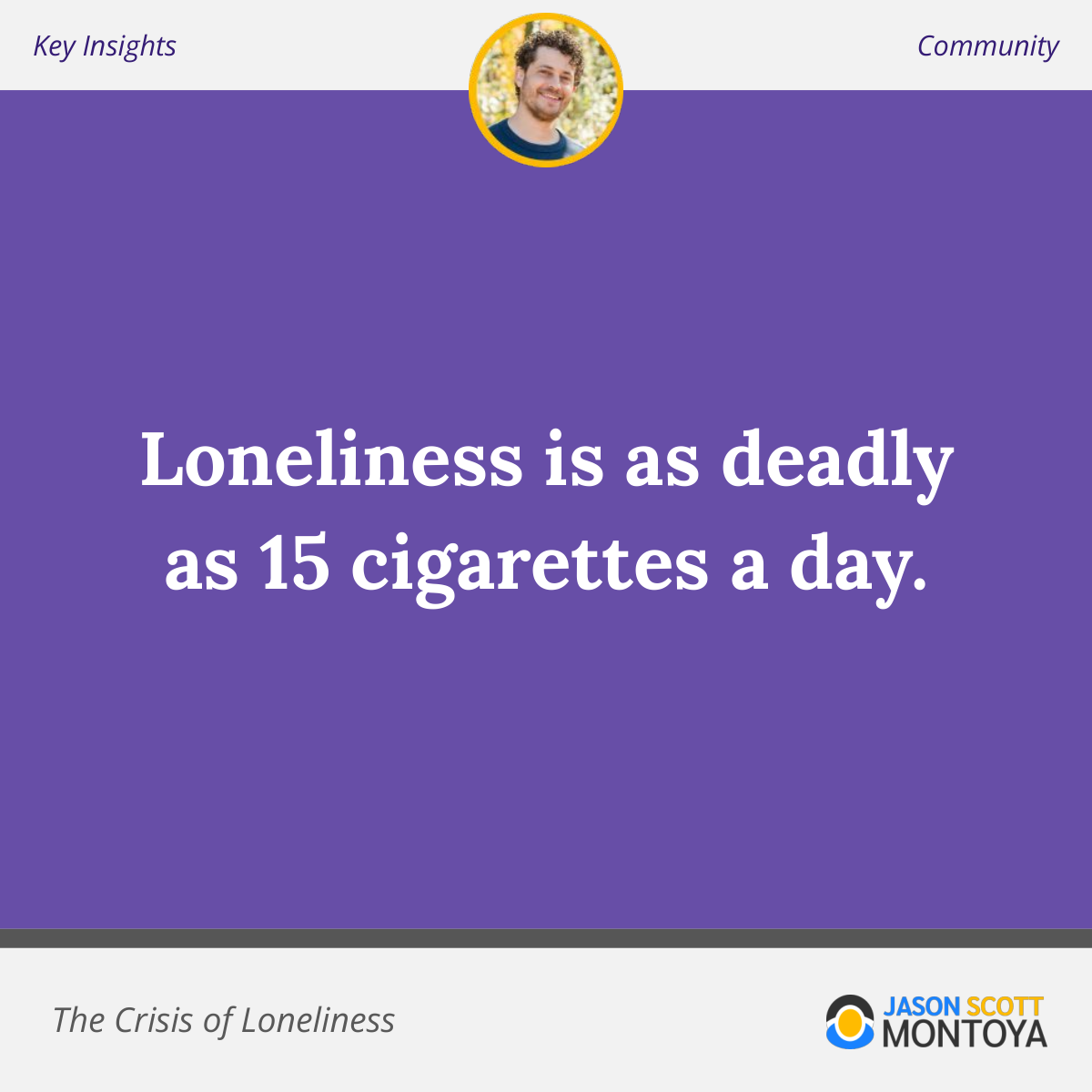
If you're unaware, the US Surgeon General has proclaimed loneliness as a public health crisis and compares it to smoking 15 cigarettes a day (in terms of how it negatively affects us).
"Loneliness is being called a public health crisis in the U.S. Experts, including the U.S. Surgeon General and World Health Organizations, warn that loneliness carries health risks comparable to smoking 15 cigarettes a day. They are calling this a public health crisis of loneliness." - Jim Karwisch, Untangled Narrative
Loneliness is a big deal.
But do we even have a handle on it?
Wrestling With "What Is the Problem of Loneliness?"
This is the great question my friend Allen Helms asks in the following video clip.
"Are we trying to attack that as a universal problem, or is it only a problem when a guy gets so lonely that he ends up doing something horrible and winds up on CNN because he killed some people or something?" - Allen Helms, Organic Endeavors
Are we trying to attack that as a universal problem?
Do we care enough about the people directly affected, or do we only care when it hurts our lives?
We have to grapple with the problem of loneliness and its many layers. And it's not so straightforward.
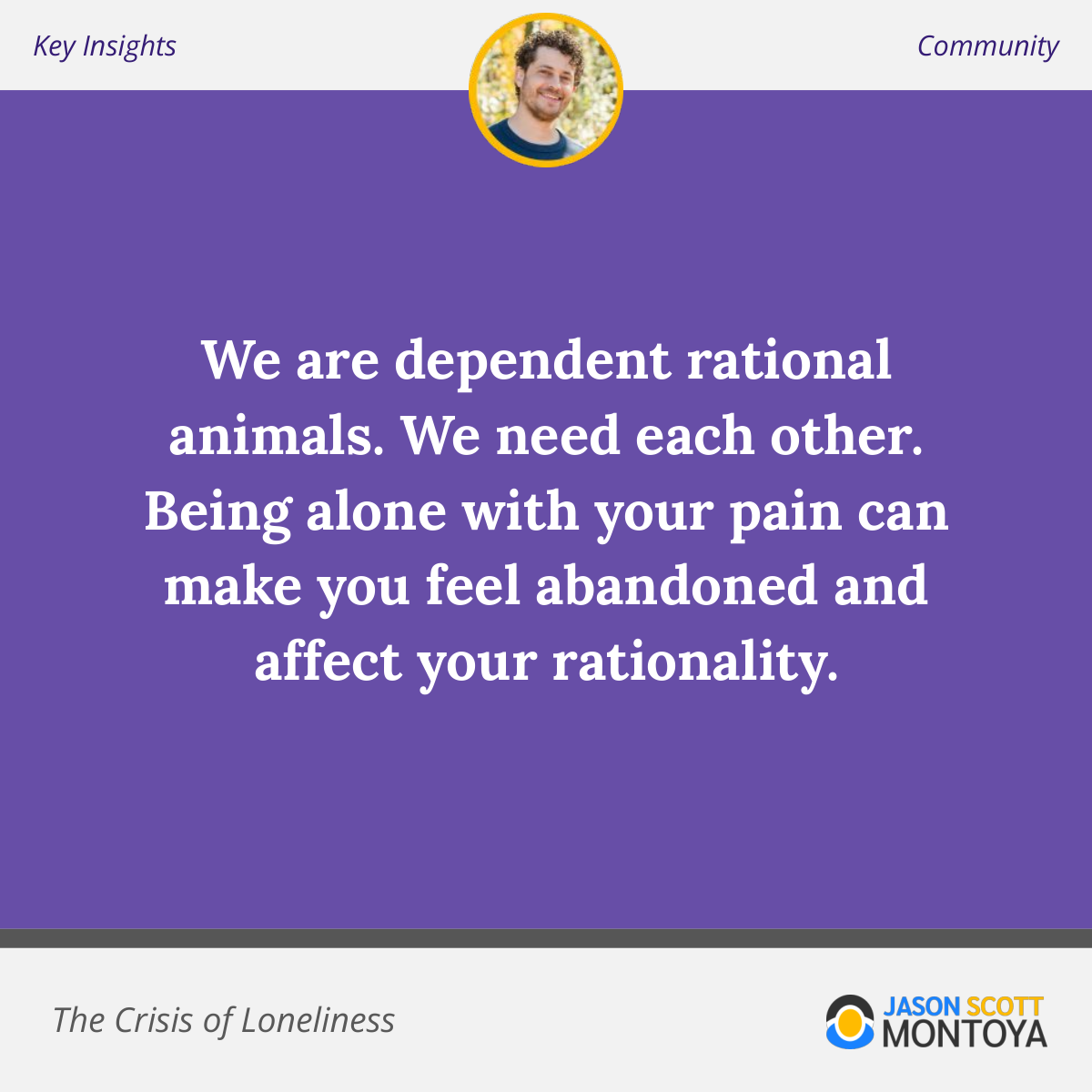
Plus, the problem of loneliness makes life much more difficult than it is together. We are dependent rational animals. We need each other.
This is Why Feeling Alone Makes Challenges 10 Times Worse
That's my claim in the following clip.
Being alone with your pain can make you feel abandoned and affect your rationality, as our minds depend on community to function. This feeling can be more pronounced even when there are people around you, but you feel unsafe or unable to talk to them.
Now that comparison of 15 cigarettes a day isn't so far-fetched sounding...
After sharing a bit of my story, we've explored, in this newsletter, that it’s not simply the state of being alone, but a deeper ache of surviving in isolation—a feeling of "forsakenness" that stands as the opposite of the Thriving Together life we are called to embrace.
And loneliness isn't just a matter of feeling sad; it’s a dangerous condition that impacts our entire being, in body and spirit.
Unpacking 4 Causes of Modern Disconnection
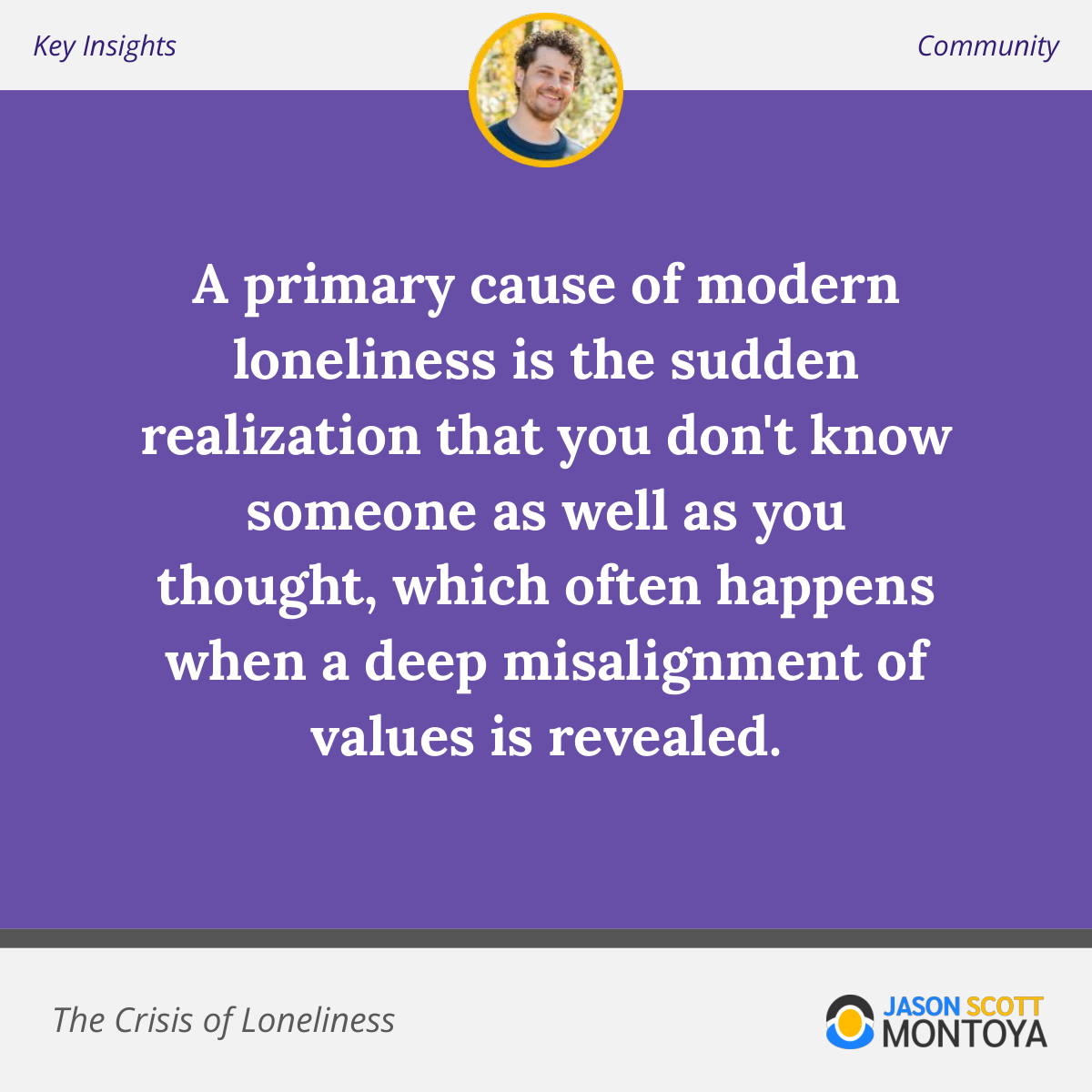
A primary cause of modern loneliness is the sudden realization that you don't know someone as well as you thought, which often happens when a deep misalignment of values is revealed through conversation or actions.
That and the following ideas are explored in that clip from our full conversation on loneliness.
Two Key Drivers of Disconnection
- Shattered Perceptions: A feeling of connection can be broken when we learn new information (like political or personal beliefs) about someone that contradicts the image we had of them. This creates an emotional distance, even if nothing else changes.
- Words vs. Actions: Disconnection is often triggered when a person's actions contradict their stated beliefs, causing you to question their sincerity and the foundation of your relationship.
As I share in the video, regarding two seasons in my journey, I resonated deeply with these dynamics. And it's this understanding that naturally leads to our next reaction and response.
Responses to Disagreement
When faced with this kind of disorienting conflict, people tend to react in one of two ways:
- Curiosity: They try to understand the different perspective.
- Avoidance: They shut the relationship down, sometimes completely.
A third option is to set new boundaries while maintaining the relationship, holding onto the tension in hopes of future reconciliation.
This is a principle that has been really helpful for me, but it does require us to see clearly.
And, it is also important to recognize that, for those with smaller social circles, the loss of even one such connection can be particularly isolating. These types of rare but pivotal events can lead to intense loss.
That's one part of the problem of disconnection. Let's jump into the next.
2. The Social Media & Algorithm Effect
Social media can amplify antagonism and create bubbles. Algorithms (along with their audience) have their own purpose (sometimes known and other times not). This fosters polarization and calcification. We explore these topics in the following clip.
Two other key ideas surface.
- The Paradox of Exposure: Social media platforms, intended to connect people, often create division. They expose users to the raw, unfiltered, and sometimes jarring thoughts of others in their social circles, while algorithms also simultaneously trap them in isolating echo chambers.
- The Need for Proactive Curation: Because users have limited control over commercially-driven algorithms, the solution is to actively manage one's information diet. This involves deliberately choosing platforms, prioritizing higher-quality content, and using tools to build custom feeds.
Moving on... We've explored the unexpected revelation of those we think we know, and humans are experiencing the chaos of social media. Now we add another layer. The loss of organic community due to innovation and technology.
3. The Loss of Organic Community
In the following clip, I share a concrete example of how technology has slowly removed the need for interdependence, which is a primary cause of disconnection.
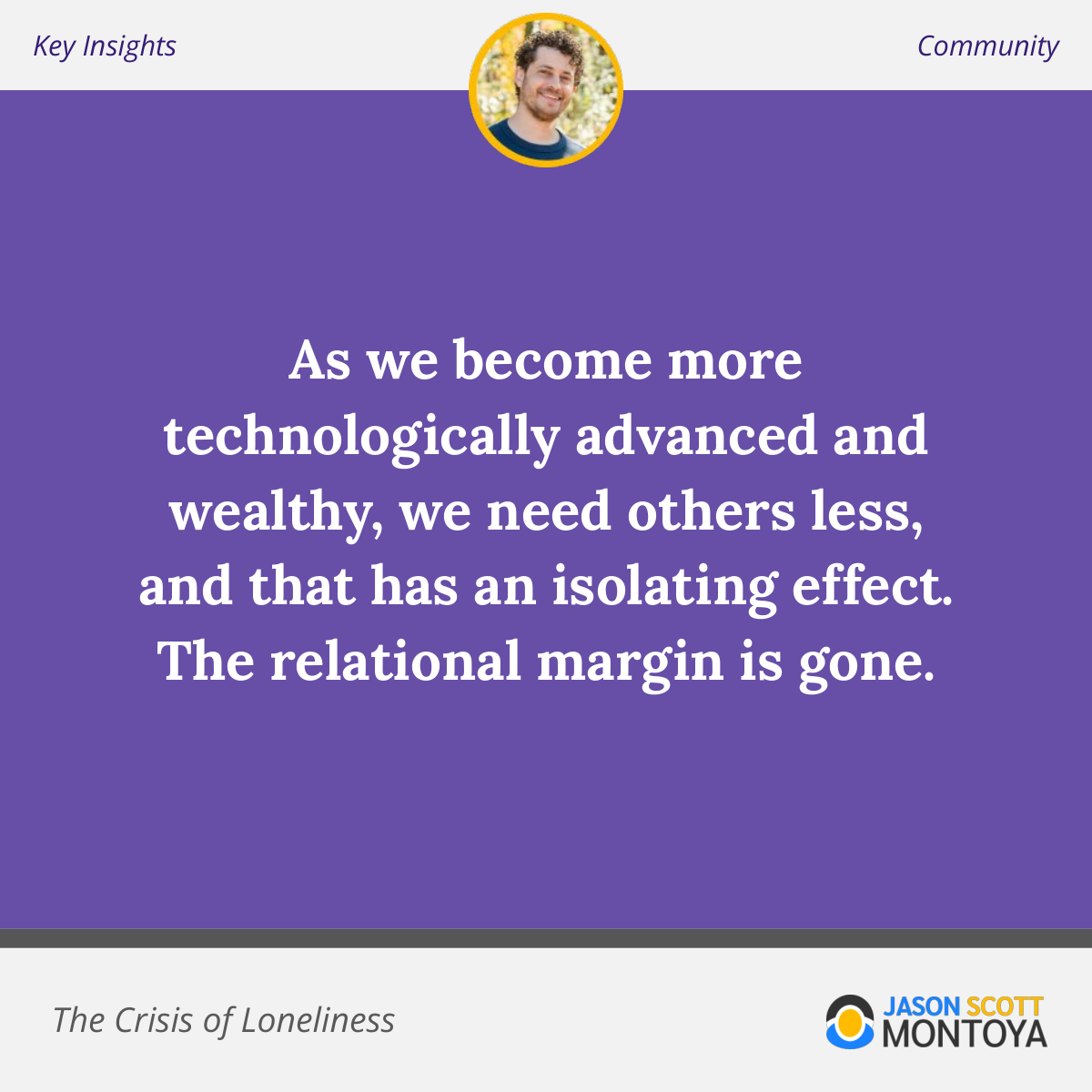
As we become more technologically advanced and wealthy, we need others less, and that has an isolating effect. Isolated, now the relational margin that allows for graceful communication is gone. And a communication breakdown unfolds (think the Tower of Babel story).
4. The Communication Breakdown
The lack of barriers to entry for online communication — how people can broadcast emotionally-charged thoughts instantly without a filter — is fundamentally different from previous forms of communication. And it's taken a toll, as we discuss in the following clip.
- Instantaneous and Unfiltered Broadcasting: The core problem is the speed and lack of barriers to sharing our thoughts. Unlike a conversation where you might pause, or an old newspaper ad that required time and money, social media allows for the immediate, public broadcast of fleeting, emotional, or crazy talk without any filter. What used to be a private, heated conversation is now a public performance.
- Loss of Context and "Weight": A crucial distinction has been lost between a carefully considered statement and a casual, emotional outburst. In the past, public statements had "weight" because they required effort and intention. Now, we often react to a thoughtless, two-sentence post with the same emotional gravity as if it were a formal declaration, leading to disproportionate anger and hurt.
- The One-to-Many Problem: Social media turns what feels like a one-to-one interaction into a one-to-many broadcast. An angry or unthinking comment isn't just shared with one person who knows your context; it's broadcast to your boss, your family, and old friends simultaneously, all of whom interpret it through their own lens, often in the worst possible way.
- Susceptibility to Rage Baiting: This environment makes us highly vulnerable to "rage baiting." Because we often take these low-context, high-emotion posts so seriously, we are easily drawn into the exact angry reaction the poster was hoping to provoke. The conversation highlights the need to recognize that engaging with this content is often "part of the game" and "part of their plan."
Practical Tip: When you write a social media post, schedule it for later. This allows you to test whether it's worth posting at all, and it also gives you time to undo that thing you intend to post, but may be best left unposted.
Wrapping Up Modern Causes of Disconnection
Ultimately, the roots of our modern loneliness are deeply intertwined.
We are simultaneously grappling with shattered perceptions of our personal relationships, being funneled into echo chambers by social media, and experiencing the loss of organic community. At the heart of it all lies a fundamental communication breakdown, where the speed and scale of online sharing strip away context and nuance, leaving us more vulnerable to conflict and more isolated than ever.
The Turning Point: Frameworks for Reconnection
This section shifts the focus from the external forces causing disconnection to the internal frameworks we can build and control. It's about changing our mindset before we change our actions.
The goal is to equip you with three powerful mental models to navigate relationships and rebuild community. 🧠
Mental Model #1. The Inner Narrative Framework
The journey toward connection begins inside your own head. Jim Karwisch explains that the inner narrative—the story you tell yourself about community, vulnerability, and trust—is the single most powerful factor in your ability to connect. If your internal script says "needing people is a weakness" or "people can't be trusted," you will unconsciously sabotage any community attempt.
Watch Jim unpack this idea in the 3-minute clip below.
Before you can change your world, you must examine your story. This mental model empowers you to take control of the one thing you truly can: your own perspective.
Mental Model #2. The "Source Determines Weight" Framework
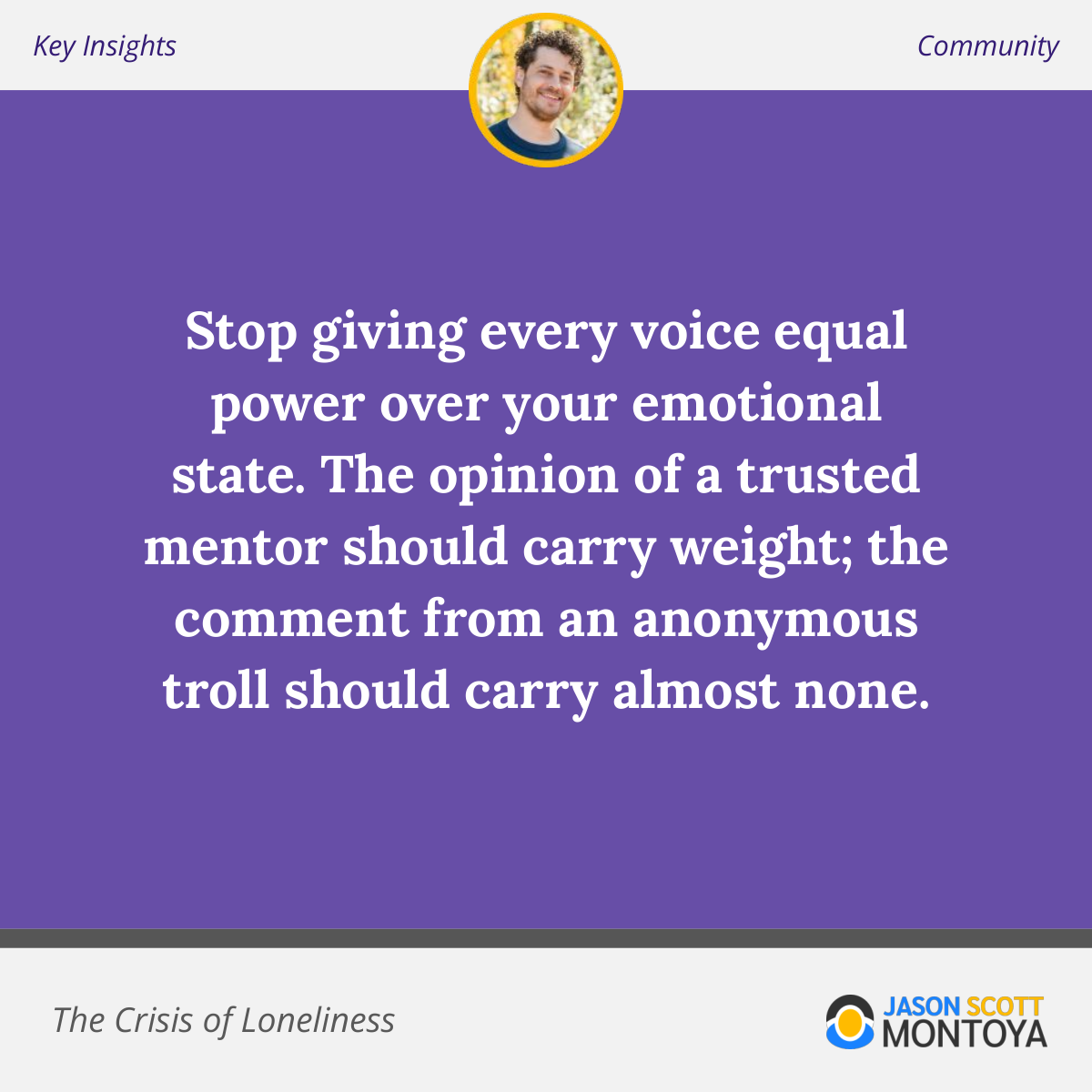
This is the essential tool for surviving the chaos of the modern world, especially online. I introduce the concept that you must learn to assign "weight" to information based on its source (informed by Andy Stanley's weight framework). The opinion of a trusted mentor or a loving partner should carry significant weight, while the comment from an anonymous online troll should carry none. I unpack this idea in the following 2-minute clip.
Stop giving every voice equal power over your emotional state. By consciously evaluating the source, you can filter out the noise, conserve your energy, and protect your peace of mind.
I'd recommend checking out this Share Life Academy workshop on seeing clearly and stopping self-deception to dive in deeper.
3. The "Nuanced Trust" Framework
Trust isn't an all-or-nothing gamble. I add a layer of practical wisdom by explaining that trust is situational. You can trust different people with different things. You might trust your neighbor to watch your dog but not to give you financial advice, and that's perfectly okay.
Watch Karwisch and me unpack this in the following 2-minute clip.
This idea of nuanced trust frees you from the pressure of having to trust people completely or not at all. It allows you to build a resilient social network by selectively letting people in based on their strengths, making the process of rebuilding community feel safer and more manageable.
Ultimately, these three frameworks are not separate ideas; they are an interconnected system for rebuilding connection from the inside out.
Your Inner Narrative is the foundation—the personal operating system you choose to run on. The Source Determines Weight framework acts as your essential firewall, protecting that system from the noise and hostility of the outside world. Finally, Nuanced Trust is the smart, savvy application you use to go out and build safe, strong connections.
By mastering these mental models, you shift from being a victim of modern disconnection to becoming the architect of your own community, fully equipped to build a life of deep and meaningful relationships.
Loneliness: The Call to Action – A Practical Guide to Reconnection
Now, we dive into the final, most important question: "What do I actually do?"
This is the call to action. As C.S. Lewis wrote, the impulse is to "go out of the self... to heal its loneliness."
This section is about the "how." It’s not about one grand, overwhelming solution.
As you’ll see in the clips below, it’s about small, consistent, and intentional actions that move the needle from "solving" loneliness to simply "improving the situation."
Action 1: The "Small Experiment" Mindset
Before we act, we have to adopt the right mindset. Trying to "solve loneliness" is like trying to boil the ocean—it's so massive, it leads to paralysis. The key is to reframe the goal.
In this first clip, Jim Karwisch breaks down the difference between "solving" and "improving." The path forward starts with one small experiment: identify one relationship you miss and take one small step to reconnect.
The margin of improvement from one simple coffee invitation can be immediate and profound.
This shift in perspective is everything. It takes the pressure off and makes reconnection an achievable, step-by-step process.
Action 2: The Power of Intentional Intervention
Reconnection requires "going out of the self."
It demands that we intervene—both in our own lives and in the lives of others.
The most powerful way to do this is to create a safe place by being vulnerable first.
In this clip, I share a personal story about how a friend’s vulnerability about his own struggles made it safe for me to share mine.
True connection often requires "providential" intervention, but it also requires us to be available and willing to share the scary parts of our stories.
Action 3: The Anti-Social Media Strategy: Be "Weighty"
We cannot fight the "fire hose of social media" with more superficiality. The antidote to shallow, algorithm-driven connections is to be intentional, individual, and "weighty."
In this next clip, Jim and I discuss the practical-but-powerful strategy of building community one person at a time. It starts with a simple lunch. By adding one person, and then another, you are making a weighty investment in someone else. This is the hard, necessary work that actually builds supportive, caring relationships.
Action 4: The Compounding Interest of Consistency
"Weighty" relationships aren't built in a day. They are forged through consistency.
In this final clip, Allen Helms shares his personal example of starting a weekly group for fellow entrepreneurs. It began with a professional focus, but through the power of a consistent, weekly meeting, it evolved into a true community. They built familiarity and a space where they could talk about everything.
A Deeper Loneliness: The Craving for Nuance
As we take these actions, it's helpful to know why we're doing it. For many of us, the isolation we feel isn't just about being alone. It's a deeper, more specific "intellectual loneliness."
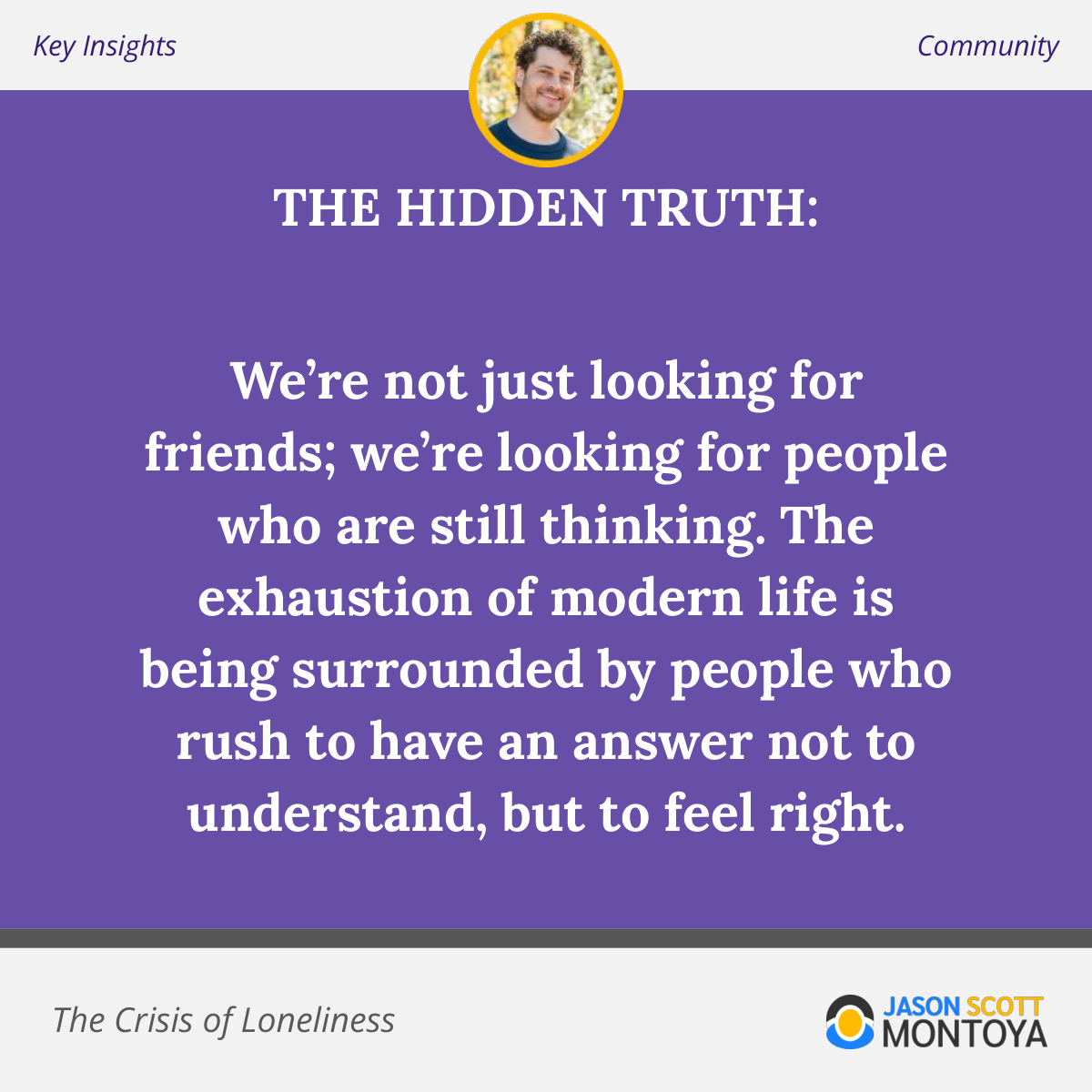
It’s the exhaustion of being surrounded by people who "rush to have an answer not to understand, but to feel right." It's the silence that follows when you say something that doesn't fit a pre-approved script.
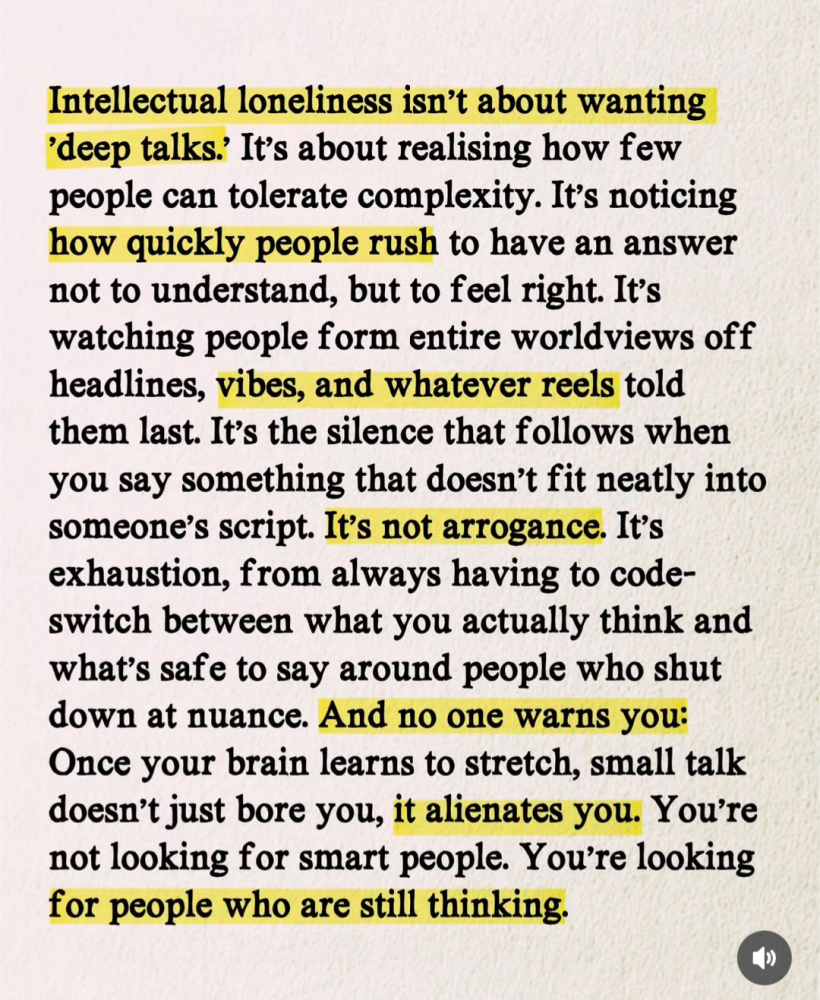
This is what we're really fighting for. We're not just looking for "friends"; we're looking for people who, as the quote says, "are still thinking." (You can read more on this profound idea at NeuroLaunch here)
This is why the "weighty," vulnerable, and consistent actions from the clips are so vital.
They are the only way to find and build relationships that can handle complexity and nuance.
The Final Word: The Stakes of Inaction
The journey from isolation to connection is the defining challenge of our time.
As Scott Sauls writes, loneliness hurts because it's a direct assault on how we were created to live. We see the consequences of this epidemic everywhere.
This is the world we're heading toward if we choose inaction.
But that is not our story. The solution is in our hands.
It's in the "small experiment" you'll try this week.
It's in the vulnerability you'll show.
It's in the weekly lunch you'll schedule.
It's in the choice to "go out of the self."
This is the journey from surviving to thriving. Together.
Watch the full loneliness conversation on the Share Life podcast below.
Share on Social Media
Related Content


