
I recently published a post with an AI generated graphic on Facebook about how freelancers should approach artificial intelligence.
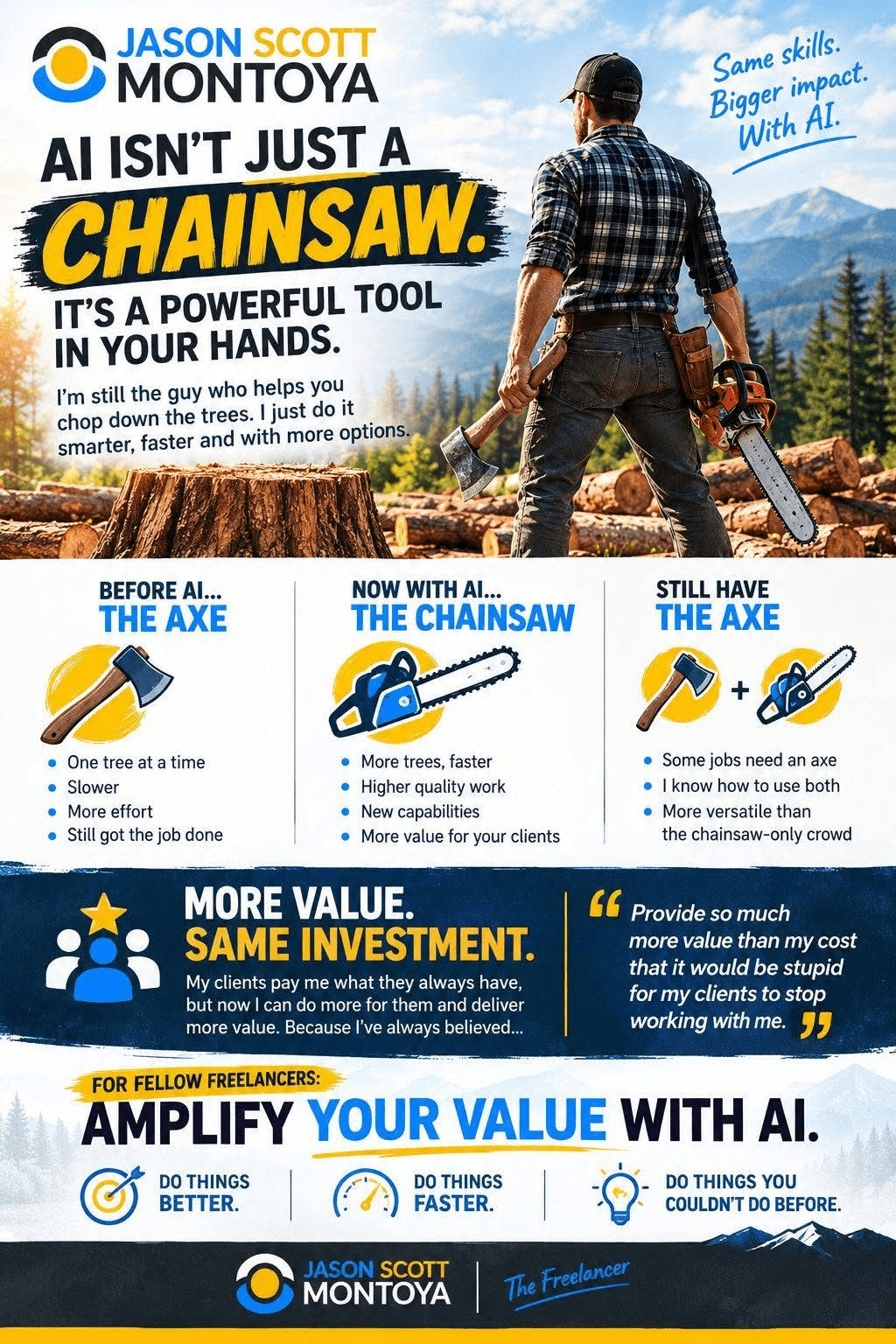
The core was simple: before AI, I chopped down trees with an axe (metaphorically speaking). It was slow, manual marketing work, yet it built foundational judgment.
Now we marketers have chainsaws (AI in my metaphor).
A chainsaw (AI) doesn't replace the lumberjack—and when amateurs use it without underlying craft, you just get AI slop, one reason why many people distrust the technology.
My closing challenge to fellow freelancers was straightforward: "Amplify your value, not the noise."
Here is the irony I walked straight into: to illustrate a post warning against generic AI noise, I attached an obvious AI infographic.
I didn't spend hours art-directing the visual. I allocated my time to sharpening the written message and used a quick, template-style graphic to get the post out the door and test how the idea landed.
What happened next turned into a live case study—not just on Facebook, but in human psychology, creative expertise, and the massive fog of war currently reshaping how we tell the genuine from the counterfeit.
1. The Experiment: One Post, High Reach, and Three Distinct Reactions
By every quantitative metric, the post worked. Out of roughly 100 posts I had shared over the previous 30 days, it ranked as my fourth most popular Facebook post —outperforming plenty of my hand-crafted, high effort original posts (I partially attribute that to the solid message and metaphor itself).
Because the core message stopped people mid-scroll, the post accumulated enough early dwell time to break out of my immediate friend circle and enter broader discovery feeds. And once a post reaches outside your bubble, it attracts more than just your target audience. It brings in the critics.
Looking through the comment threads, three distinct archetypes emerged:
-
The Good-Faith Critique (Robert): Robert—a developer using AI tools locally for retro video game asset generation—called out the tension between my message and my medium immediately. "If you’re so proud to be an AI-assisted designer/developer/lumberjack(?), why are you generating flyers with the default settings?" he asked. "You realize the 'AI-style' that's held in such low regard is the lowest common denominator... I feel like posting up a default style flyer is the equivalent of formatting your entire document in Times New Roman or Comic Sans. It works, but it's not really using the full capabilities of the tool."
-
The Moral Outrage ("Ruining the Planet" Guy): Another commenter, Neil, bypassed the freelancing message altogether to make a sweeping ideological indictment: "This is a great metaphor. AI is literally ruining the planet to benefit some billionaires, and it's users love to pretend they're experts at something I stead of imbecile peons."
-
The Bad-Faith Dunk: Then came Stew, an old acquaintance from the opposite side of the political aisle. Rather than engaging with the substance of the post, he zeroed in on the flyer as a reason to dismiss the entire effort: "What a waste of AI's potential. Everyone seems to be using the same generic flyer for everything... No creativity, no originality, no diversity... In some cases, the only engagement you're getting is people hitting the block button. 😂"
2. Inside the Comment Section: When Good Faith Meets Bad Faith
Watching how those threads unfolded side-by-side revealed a sharp divide in how people engage with tension online.
With Robert, the critique was rooted in craft.
When I explained my workflow—that I test messages first with lean visuals and invest deeper art direction once a concept proves it has traction—he leaned in. He shared YouTube resources on prompt engineering, showed off screenshots of a custom Commander Keen / Duke Nukem 2 mashup he was debugging in ComfyUI, and swapped notes with me on a retro LucasArts point-and-click graphic I had built for a client.
After watching the video Robert shared, this quote from Candice Bobchak stuck out to me:
"Don't think of prompting as finding the magic sentence. Think of prompting as art direction. You are establishing your priorities. You are setting constraints. You are communicating context. You are making decisions about what belongs and what doesn't."
With Neil—the ruining the planet commenter—humor and grounded conviction diffused the hostility. I joked about chopping down the Lorax's home together before stating my actual view: AI democratizes skills and levels the playing field, and we have a responsibility to build and use it sustainably without destroying the planet or ourselves in the process. When he replied, "you see it that way because you're a fool," I simply answered, "Very foolish indeed 😉"—and moved on.
Then there was Stew.
I stepped into the tension with him in good faith. I acknowledged his observation openly: "Here I did the basic image generation without spending the time on making something original or unique because my goal was more about testing the message and getting it out."
I noted how fascinating it is that an obvious AI layout triggers visceral anger today when an equally unoriginal human-made template ten years ago would have simply been ignored. To meet him halfway, I even attached a completely different, photorealistic AI-generated image of an axe and chainsaw resting on a forest stump—asking whether the real issue came down to his initial point about utilizing a tool's full potential, much like keeping a Ferrari in the garage and only driving it around the block.

"it just comes off as you don’t really care, so why should someone else. It’s really simple, and no need for a long pointless and exhausting conversation. And low IQ analogy lmao. Good try."
3. The Reach Tax: Why Attention Attracts Both Value and Noise
At first glance, Stew's comment creates a paradox. If generic AI graphics make everyone tune out or hit the block button, why did the post perform so well? Why did he engage?
Because vocal cynics are not the silent majority.
Modern social media discovery engines run on dwell time—whether real human beings pause on their screens to read what you wrote rather than swiping past in half a second. If the silent majority had truly been repelled by the image, they would have scrolled right by, the post would have stalled at a few dozen views (like many of mine do, including some obvious AI generated graphics), and Stew never would have seen it in his feed in the first place.
Instead, hundreds of silent readers stopped, read the caption, absorbed the framework, and moved on. Their quiet attention pushed the post into wider discovery waves—and those wider waves inevitably dropped the post in front of a small slice of critics.
In public writing, negative comments from drive-by cynics aren't proof that your message failed. Often, they are simply the distribution tax you pay when your work breaks out of your echo chamber—and ironically, their comments add fuel to the very engagement engine that delivers your message to the people who actually want it.
4. The Pushback is Not About Effort or Care—It’s About Expertise
Still, stripping away Stew's bad-faith delivery leaves a real question worth examining: Why do obvious AI templates trigger people so strongly, and what actually separates good work from noise?
Stew claimed a default AI image signals that "you don't really care."
I don't think it's about effort or care at all.
It's about expertise and competency.
Think about it this way: if I spent three hours manually building a graphic in Photoshop, and the final result still ended up looking like a generic AI flyer, people would punish it the exact same way. Audiences cannot see your time logs or your effort; they can only react to the visual signal hitting their eyes in the first half-second.
Conversely, once you develop real skill with the tool—learning how to art-direct constraints, strip out glossy digital gradients, and design tactile, brand-aligned visuals (like a candid overhead snapshot of a hand-drawn ink diagram in a Moleskine notebook)—creating a dramatically better visual takes the exact same effort, or even less, than generating a generic flyer.
It comes down to a simple visual metaphor: carving a bear out of a tree stump with a chainsaw.
If you watch a skilled artist take a chainsaw to a raw block of wood and carve an intricate bear, it is mesmerizing.
People stop and watch because they recognize mastery over a dangerous, powerful tool.
If someone takes that exact same chainsaw to a stump and produces a lopsided, mangled lump that barely resembles a bear, nobody cares how hard they sweated—viewers feel like their time was wasted.
And an important note. Technical skill with the tool has to pair with cultural fluency—the sensitivity to notice when a visual style has hit saturation.
Every design trend goes through a lifecycle: novelty, mass adoption, and eventually ad blindness, where audiences develop an automatic immune response to a format that feels overused or manipulative.
True expertise isn't just knowing how to generate an image; it's recognizing when the room's eyes have moved on.
5. Genuine vs. Counterfeit: Navigating the Fog of War
This brings us to the deeper shift happening beneath all of these online skirmishes.
For the past decade, surface polish—clean typography, studio lighting, symmetrical layouts—served as a reliable shortcut for identifying real competence. If something looked professionally designed, you could reasonably assume a skilled human invested real judgment into making it.
Today, our filters for seeing what is genuine versus counterfeit are covered by a fog of war. We care because this signal helps us determine what's worthwhile.
Generative tools have enabled the masses to replicate surface-level design polish in seconds.
Because audiences and creators have not yet fully adapted, experts and amateurs are temporarily producing output that looks remarkably similar on the surface (some deserve the admiration, while others do not).
That ambiguity triggers anxiety—and in that fog, calling out an obvious AI graphic becomes an easy way for critics like Stew to signal superiority: "I see through the counterfeit; I'm already ahead of this trend."
When surface polish becomes cheap and infinitely replicable, it loses its value as a trust signal.
That means the next wave of design—and the next wave of leadership and communication—won't be won by whoever has the slickest template.
When anyone can fake high-gloss perfection, taste, restraint, original thinking, and unmistakable humanity become the scarce assets.
Right now, people and experts alike are developing new eyes. As those filters sharpen, the fog will clear—and the counterfeits and incompetents who relied solely on automated polish will be exposed as the sifting plays out.
The signals in this experience help me see what those dynamics might be and how to proactively navigate them as this unfolds. True experts shouldn't fret because their expertise will carry them much further along than the amateurs captured by the tools they use.
Where Do You Stand in the Sifting?
Whether you are building a freelance business, leading a team, or sharing ideas in public, the tool in your hands isn't the differentiator anymore.
Everyone has access to the chainsaw.
The real question is whether you are developing the judgment, taste, and foundational craft to carve something unmistakable—or simply adding more noise to the feed.
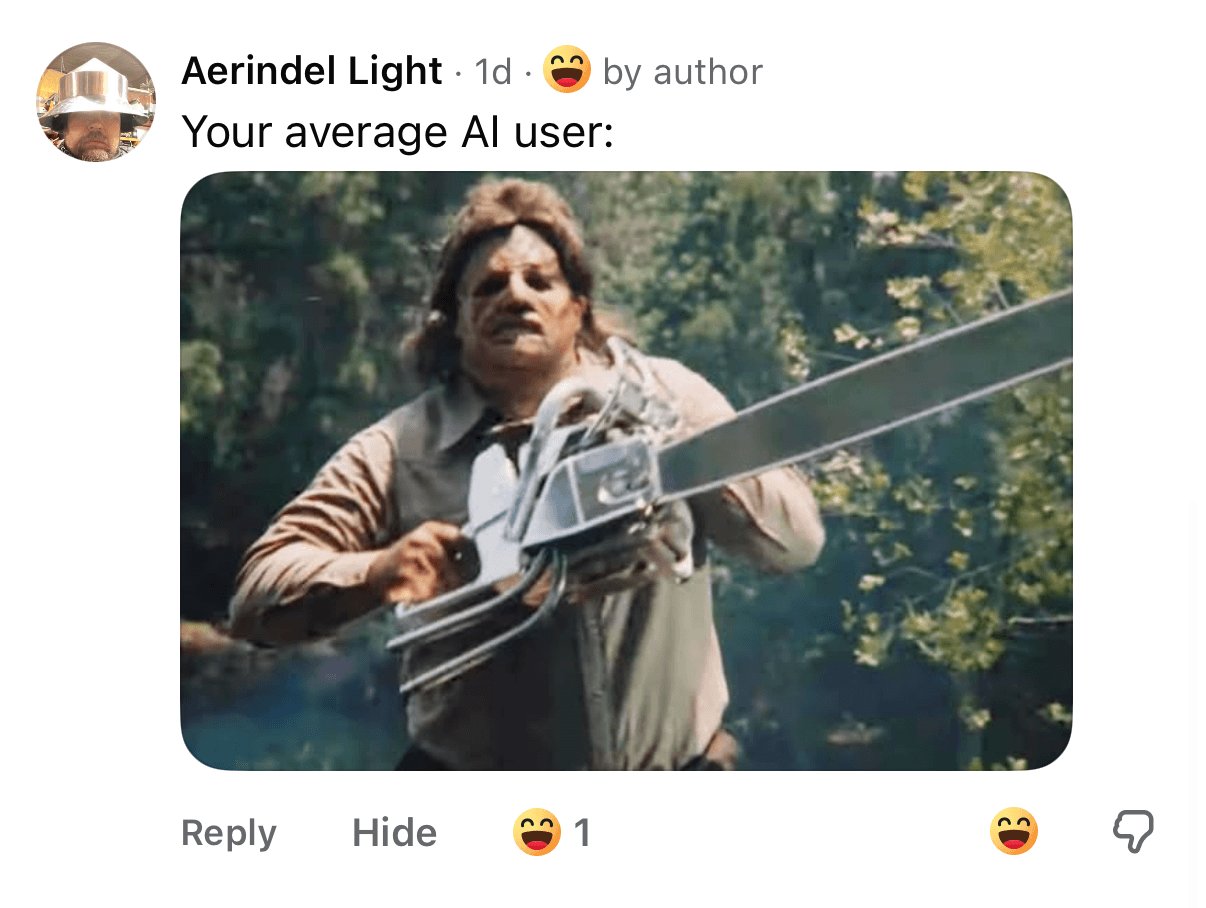
Are you the chainsaw master crafting cute bears out of trees or leatherface working the next chainsaw massacre?
Next time you create or share something, take the next step: look past the surface polish and ask whether your work carries genuine human conviction, or just a clever wrapper.
Related Content


