
In my first two essays on navigating AI as a creator, I looked outward at the arena (Genuine vs. Counterfeit) and inward at the soul of the maker (Trading Refuge for Truth).
Then I ran two new experiments—one on my personal profile, and one on my Facebook Page.
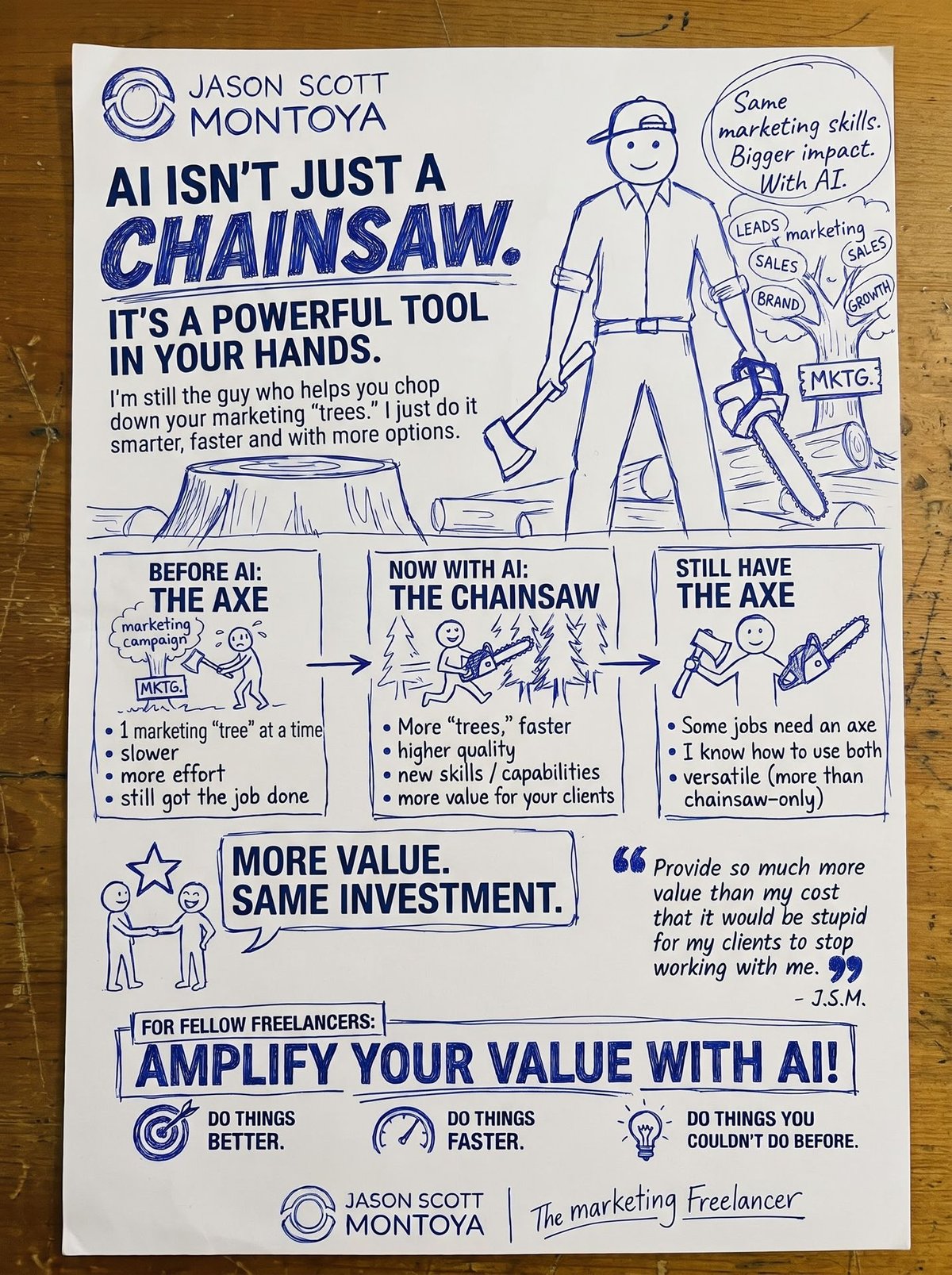
First, instead of the generic, glossy AI flyer that triggered the trolls in round one, I spent real time creating a completely different visual approach for my personal profile: a tactile, hand-drawn blue-ink schematic resting on a wooden desk (still ai-generated).
It laid out a simple, practical message for fellow freelancers—showing how AI isn't a replacement for your craft, it's a chainsaw alongside your axe.
Algorithmically, it worked. Once again, the post broke through the Friendship Ceiling and outperformed many of my actual handmade posts.
There was just one small hitch.
Inside the foliage of the tree on the right side of the sketch, the AI duplicated the word "SALES" twice (LEADS, marketing, SALES, SALES, BRAND, GROWTH). I didn't catch it—or, honestly, care enough to catch it—before hitting publish (I probably would have left it had I noticed).
Within minutes, the comment section lit up. One stranger announced they were blocking me. Another dropped a drive-by "Dumb." And a marketing professional named David chimed in with a detailed critique:
"They failed at using AI effectively. There is a very important step they missed, editing and its a big reason people hate AI. Successful marketing requires the add to feel correct to the viewer. If anything is off about it, it creates an itch in the mind that turns people away. The tree saying sales twice for example feels unnatural and shows a lack of care. Its a small detail that someone might not even notice but still makes them feel like the image is just wrong."
Around the same time, I shared the original graphic on a delay to my public Facebook Page—a space with virtually none of the personal friend buffer my profile enjoys.
Almost immediately, cold strangers arrived to pile on: one dropped a drive-by "This ad looks like dog shit btw," another left a silent thumbs-down emoji, and a creative named Ecko delivered a sweeping takedown:
"Your ad doesn't have any value, it's the same thing we see everywhere from AI... No real notion of ergonomic, over crowded page, over use of line to split section into sub section, Big bold text on paint stripe (very 2000ish graphic). What's really happening is a big devaluation of the market/product, because everyone think they're producing quality graphic with AI for free or cheaper. The real kicker is gonna be when AI platform start charging you so they can make a profit of it and than it's gonna cost more than an actual person to create."
Look closely at what happened in both threads.
Even though I spent more time designing the hand-drawn schematic than many of my handmade posts, one tiny duplicated word was treated as a moral indictment ("shows a lack of care"). And on a cold Page, an AI graphic that had already sparked real conversations was declared to have "no value" at all.
More care and intention didn't mean the critiques went away.
So, why does such small friction trigger such disproportionate heat?
1. Algorithmic Identity-Routing and the Threshold of the Platform
Years ago, social media ran on a Social Graph—your posts were shown mostly to friends, family, and peers who knew your character and intent. Today, discovery engines run on an Interest Graph (my preferred approach).
When a post gains traction—or lands on a public Page without a friend buffer—the algorithm detaches it from your personal circle and drops it directly into the feeds of complete strangers.
Even more importantly, the algorithm doesn't drop your post into a neutral room—it acts like an identity magnet.
Just as posting about the toxicity of Donald Trump routes your words straight to MAGA loyalists primed to defend their political tribe, using AI to do creative work routes your graphic straight to designers, art directors, and creative professionals whose identity and livelihood are tied to traditional craft (because they're compelled to engage).
But when I compared these AI posts with my political posts, I noticed another wrinkle.
I’ve used AI-generated imagery to accompany political messages, too. And while those posts can certainly invite disagreement, the reactions I’ve noticed have tended to focus on the political message—not on the AI graphic carrying the message. They haven’t generally sparked the same visceral response to the image that these posts about AI have.
Here, the content and the container collide.
I’m talking about how creators can use AI—and using an AI-generated image to carry that very message. The vehicle itself becomes part of the argument, and some readers seem to judge the idea by inspecting the graphic before engaging the point I’m making.
Now, the container matters (more than before, at least on this topic). If the graphic obscures the message, that’s worth examining. But there’s a difference between asking whether the vehicle serves its purpose and dismissing the idea because of the vehicle—or a flaw in it.
So here’s the possibility I’m exploring: when the message is about AI, the AI container becomes the target, too. When the message is about politics, the politics may hold the spotlight instead.
That’s an observation from my posts, not a controlled experiment (the audiences, topics, and posts aren’t identical). But it gives me another question to carry into the next experiment: are people responding to what I’m saying, how I’m saying it, or the uncomfortable overlap between the two?
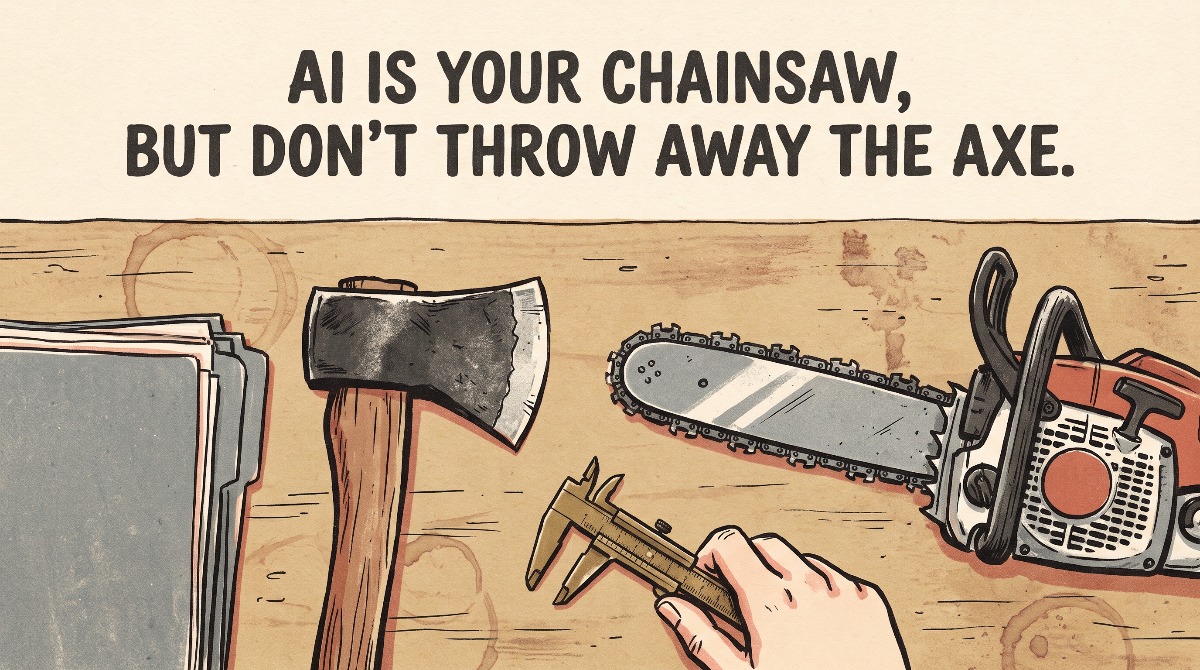
Then I posted another carefully crafted AI-assisted image about AI, again using the chainsaw metaphor. It took off, too. This time, I didn't see any errors or obvious AI tells in the image.
Someone responded with a GIF calling it “Abysmal Dogshit.”
Ten people liked the post (as of publishing this).
That comment doesn't tell me exactly what each person disliked, or prove the image was perfect. But it complicates the easy explanation that the backlash is simply about sloppy execution. A carefully crafted image can still draw a visceral reaction when the idea it carries—using AI positively—is itself controversial.
At the same time, many people navigating the changes valued it, but their likes don't tell me why.
So, we're going to have to throw out some ideas to reconcile the reactions. Visual artist and YouTuber Kayla Carlile, reflecting on what happens when a creator's work crosses into viral reach, captured this exact shift:
"People's comments on your posts have nothing to do with you. You pass a threshold where people no longer view you as an individual. When you go viral, you are now a platform for them... People are competing to leave the best comment. Really, they're viewing you as a platform for their popularity contest."
Once you cross that threshold into a zero-trust public square, commenters aren't engaging you—they are performing for their own tribe's applause.
This was something I discovered listening to the Witch Trials of JK Rowling (author of Harry Potter). Once you hit a level of scale, regardless of who you are and what is your message, you're going to elicit a negative reaction froms someone somewhere.
In my movie industry essay Vice Grip, Vanilla Slop, and the Hostile Attack, I called this The Dialogue Symptom:
With Trust (Friends): A clunky line—or a duplicated word on a hand-drawn tree—is forgiven as "charming" or a harmless human quirk.
Without Trust (Tribal Strangers): That exact same flaw becomes proof of "creative bankruptcy" or moral negligence ("shows a lack of care").
When people react out of tribal defense, they also stack unrelated complaints to justify a predetermined verdict. Look at Ecko’s comment: first he attacks novelty ("the same thing we see everywhere from AI"), and then he pivots to execution ("no real notion of ergonomic, over crowded page... very 2000ish graphic"). Yet novelty and craft are two completely separate axes—something can be 100% novel and poorly executed, or 0% novel (a ubiquitous template) and crystal clear in accomplishing its aim.
Then the original graphic entered another room. After the first experiment embedded in Genuine vs. Counterfeit—and my reflection on the creator’s inner response in Trading Refuge for Truth—I shared that same graphic on LinkedIn. The post has received more impressions than my typical LinkedIn post. It also received a like, and my client Jessica Lalley left this comment:
“I am so very grateful for your expertise and ability to dig deep into the technology and utilize it in a way that has really blessed my business and clients! Keep on chopping! 🪵”
Same graphic. A different encounter.
On Facebook, some people scrutinized the container. Jessica spoke to the expertise and application of the technology—and the value she experienced in her business and with her clients. She connected (because she experienced) with the message behind the chainsaw.
Her response doesn’t erase a valid design critique, and one comment can’t tell us how an entire platform will react. But it does remind me that a person who knows my work brings context a stranger may not have. The relationship changes what is visible.
And there’s a temptation on the other side of the arena, too: to cling to praise as proof that every critic is wrong. If I’m going to seek truth rather than refuge, I need room for both—the correction that helps me improve and the encouragement that reminds me who the work is meant to serve.
Think about the paradox this creates. The very mechanism that gives your ideas reach (algorithmic discovery) strips away the relational context that helps people receive them with grace. In a zero-trust room, it can feel as though you have to be perfect. Yet even a carefully crafted image may not protect you from a strong reaction when the subject itself is contested.
2. Proportionality to the Aim (And the Irony of the Purist's Typos)
I was curious to see what was really driving David’s reaction on the hand-drawn tree, so I replied with a simple question:
"If it was hand drawn, the artist chose to intentionally put sales in there twice or they made some other different mistake, would you feel they didn't care still? Is an ad with a mistake the problem here or is it an ad with a mistake that was made by AI the problem?"
David doubled down. He insisted that any marketing director would reject it—claiming that flawlessness is what separates a "successful marketing campaign from a faild [sic] one, and the skilled designer from an amateur."
Now, pause and look at the unintentional irony sitting right inside both critics’ comments. In his first note lecturing me on editing, David wrote "add" instead of "ad." In his second note lecturing me on professional flawlessness, he wrote "would would" twice in a row and misspelled "failed" as "faild." Meanwhile, Ecko lectured me on design precision while writing "everyone think," "AI platform start," and "profit of it and than."
It proves a deeper truth about human communication: we all leave typos in our wake when we are thinking out loud in good faith.
If I called David an amateur over "faild," he would rightfully say, "Jason, it's just a quick Facebook comment, not a national billboard."
By that exact same logic, an organic social post is a live concept test, not a $100,000 ad buy.
When we judge creative work without factoring in proportionality to the aim, we collapse every container into one—demanding Super Bowl commercial polish on a $0 experimental post while forgiving our own typos in the very next breath.
But proportionality is not permission to publish anything just because it was cheap to make. A low-cost experiment still needs something worth testing: a real observation, a useful question, a lesson drawn from experience, or an idea that helps someone see a problem differently.
A graphic can be imperfect and carry a valuable insight. It can also be polished and carry nothing at all. The question isn't simply whether the tool made the work faster—it's whether I brought something to the work beyond what the tool could assemble on its own. In this case, I did.
And the standard changes with the stakes. A duplicated word in a quick concept post is different from an inaccurate claim in advice someone relies on, or an error in a client's paid campaign.
The more consequential the work, the more checking it deserves.
3. Reconciling the Economic Reality: Email, Secretaries, and the Subscription Cliff
To read Ecko’s comment fairly, however, you have to separate his subjective design gatekeeping from his legitimate economic observation. Underneath his typography critique, he gave away the real nerve:
"What's really happening is a big devaluation of the market/product... The real kicker is gonna be when AI platform start charging you so they can make a profit of it and than it's gonna cost more than an actual person to create."
He isn't wrong about the market shift. Generative AI is devaluing routine, mid-tier graphic execution—and once venture subsidies dry up, AI platform costs will climb.
We have seen this exact movie before. When email, word processors, and calendar software became standard on every desk, the traditional secretarial typing pool was radically devalued.
Executives no longer needed a specialist just to format a memo or type a letter. Yet the role didn't vanish—the floor collapsed while the ceiling rose.
Mechanical execution became a self-serve utility, while high-level judgment, taste, and strategic leverage became more valuable.
That is how we reconcile Ecko's warning without surrendering to fear:
- Commodity execution gets automated: If a designer's primary value is arranging text boxes and divider lines, AI turns that into a utility—just like Word did to typing pools.
- Strategic judgment and taste rise in value: Devaluing routine execution redistributes leverage to the person with the vision, message, and taste to direct the tools—freeing human design budgets for flagship campaigns where custom craft actually matters.
There is a tension here worth holding.
As I explored in the first essay, when a polished surface becomes easier to generate, the surface alone becomes a weaker signal of expertise. Taste, restraint, original thinking, and the judgment to know what a particular audience needs still matter.
That does not mean every displaced designer will automatically find a more valuable role—or that a cheaper tool somehow makes the economic disruption painless. It means the work of deciding what to make, why it matters, and whether it serves people cannot be reduced to pressing the generate button.
I can understand the feeling of the ground shifting beneath my feet more than I might want to admit. We recently bought a 2026 Toyota Sienna, and the world of vehicle prices and affordability had changed dramatically from what I remembered years ago when we bought our Kia Sedona.
I could be frustrated about that reality—and I was (and am). But frustration alone wouldn't change the decision in front of us.
With AI, I feel that same shifting ground beneath my creative work. My response has been to pioneer and run ahead, so I can learn to adapt rather than be left behind. But not everyone wants the ground to move. And even when someone wants to adapt, they may not know how—or whether the cost of doing so will be worth it.
Adapting is hard. It has to be worth it, too.
Recognizing that doesn't mean every change is good or every cost should be accepted without question. It means I can acknowledge the loss and frustration while still asking how to respond to the reality in front of me.
Instead of attacking Ecko, I decided to test my Proportionality to the Aim thesis directly in his thread:
"Got it. Fair point on the market flooding, and I also suspect AI costs will climb. To dive deeper here: if a quick, imperfect AI graphic is just used to test an idea or start a real conversation with buyers (not replace a flagship campaign), does it still have zero value, or is there room for good enough tools alongside real human craft? As AI costs rise, maybe its proper place for experimentation and collaboration will settle more clearly alongside traditional design practices, correcting the ways its current cheapness distorts how people use it? If generating this graphic cost me $20 instead of a few cents or less, I’d certainly approach it differently before creating it. While it remains cheap, it’s a great way to test things."
Calibrating upfront rigor to the cost and purpose of the experiment isn't negligence—it's basic stewardship.
4. Surveillance, the "Printer Glitch" Paradox, and the Idol of Perfection
The most revealing part of David’s reply came at the very end, when he cited viral videos of a printer laying down a perfect pattern and ending with a single mistake:
"Those viral videos of the printer making a perfect pattern and ending with a single mistake is the perfect example it used the itch to its advantage."
Notice the paradox he accidentally uncovered.
If a human designer leaves a single flaw inside a compelling pattern, it’s celebrated as a stroke of genius that creates "the itch" to hold human attention.
If an AI-assisted schematic leaves a single duplicated word inside a compelling pattern, it’s condemned as amateur negligence.
Yet to the scrolling brain—and to the algorithm measuring dwell time—the psychological friction of "the itch" is identical. (And frankly, now that I see how reliably that little flaw hooks the eye, I know it can even be used intentionally.)
Why do purists react with such hostility when an unpolished experiment slips past their guardrails?
Philosopher C. Thi Nguyen, in his book The Score: How to Stop Playing Somebody Else’s Game (a passage Kayla Carlile highlighted in her talk), explains what happens when we subject creative exploration to public compliance audits:
"Transparency is surveillance. It puts people under the watchful eye of a suspicious public. It forces experts to be constantly worried about how their actions will be interpreted and misinterpreted by outsiders who don't share their expertise. So surveillance is useful when it's deployed against corrupt people, but it's limiting when it's deployed against the expert, the highly competent, and the extremely sensitive."
When suspicious onlookers treat every public experiment like a compliance audit, creators become paralyzed—obsessed with narrow, rigid production metrics (zero typos, traditional layout rules) while losing sight of the actual creative process and the mission it serves.
The theologian Oswald Chambers diagnosed the spiritual root of that rigidity in The Teaching of Disillusionment:
"If we love someone [or something], but do not love God, we demand total perfection and righteousness from that person, and when we do not get it we become cruel and vindictive."
When critics make an idol out of human craft, technical purity, or industry rules—without the grace of God anchoring them—they demand total perfection from the work in front of them.
When a single blemish breaks that illusion, they treat imperfection as a moral betrayal that justifies cruelty ("Dumb"), condescension ("shows a lack of care"), or relational exile (blocking).
In Constructive Developmental Theory, that is the Socialized Mind (Level 3) guarding the perimeter of its tribe—measuring legitimacy outside-in by strict adherence to the rulebook, rather than stepping back (Level 4) to evaluate whether the work actually accomplished its purpose.
5. Choosing to Be an Amateur: Stewardship of Risk Over Perfection
Recently, I scheduled a podcast clip from my client Steve Woodworth talking about why ministry nonprofits so often fail to innovate. His observation hit the exact same nerve: nonprofits take their stewardship of donor money so seriously that they refuse to take risks.
Creators and professionals fall into the exact same trap.
We take the stewardship of our "professional reputation" so seriously that we guard our polish in a vault—refusing to ship anything experimental, unpolished, or imperfect lest the purists catch us making a mistake.
And sometimes the stranger's comment lands hard because it echoes a voice we already carry.
- What if I really am an impostor?
- What if this work isn't original enough?
- What if the critic sees a weakness I've been trying not to see?
That is the inward tension I explored in Trading Refuge for Truth. I don't have to accept every accusation as a verdict on my worth. But neither do I have to hide from a useful correction simply because it arrived wrapped in discomfort.
There is a massive difference between sloppy laziness and consciously choosing to be an amateur.
Choosing to be an amateur means stepping into an unfamiliar, fast-moving arena knowing full well that flaws will slip through and zero-trust strangers will mock you for them—because learning, testing, and reaching real people matters more than looking flawless to the crowd.
Think of the amateur here as an explorer, not merely a broker repeating what everyone else has already said. The explorer goes into the terrain, tries something, pays attention to what happens, and brings back a firsthand account—including the parts that didn't work.
That's what these two posts gave me. Not proof that every imperfect graphic succeeds, or that every critic is wrong. They gave me an experience to examine, questions to test, and a conversation I couldn't have manufactured by polishing an idea in private forever.
Being willing to learn in public doesn't excuse me from learning. If a mistake obscures the message, I can fix it. If a critic identifies a real weakness, I can own it.
The point is to let the experiment teach me—not to turn imperfection into a new badge.
As my client Steve pointed out, when you take risks, you get clear on how to measure them against your actual objective so you can learn and adapt fast. That reframes the entire scoreboard: an imperfect ad with a spelling error that stops the scroll, sparks conversation, and connects with real buyers is infinitely better than a "perfect" handmade ad that gets twelve views and fails its aim.
6. Surviving at Scale: Trading the Ultimatum for the Invitation
Important note
If you are going to step into the tension of a polarized, algorithmic public square, you cannot engineer enough perfection to satisfy a zero-trust room. You have to build a different kind of resilience.
One practical way to stay grounded is to find the central point beneath the noise. What is the critic actually claiming? Does the evidence challenge the idea I'm testing, identify a correctable flaw, or simply express dislike? I can take a valid point seriously without letting an insult decide my identity—or treating every disagreement as an attack.
Watching The Hunger Games: Sunrise on the Reaping recently brought another connection into focus. Across these three essays, I’ve been wrestling with what happens when an arena shapes what we see, what we fear, and what we believe is possible.
Suzanne Collins puts it this way in Sunrise on the Reaping:
“And that’s part of our trouble. Thinking things are inevitable. Not believing change is possible.” — Suzanne Collins
That hits the temptation to treat this moment as a settled verdict: AI will destroy creative work, the critics will always win, or the only way forward is to surrender our judgment to the machine.
None of those conclusions are something I have to accept as inevitable. I can keep learning, testing, and choosing what kind of work—and what kind of creator—I want to put into the world. Collectively we'll all shape how this unfolds.
Another line from Collins speaks to the fear that can take over before we even begin:
“So don’t feed the nightmares. Don’t let yourself panic. Don’t give the Capitol that. They’ve taken enough already.” — Suzanne Collins
A hostile comment section is not the Capitol, and a creative experiment is not a fight for survival. But the question of what we do with fear still resonates. Do I let imagined verdicts keep me hiding, or can I acknowledge the risk without feeding the nightmare?
That idea connects all three essays: look past the surface to find what is genuine, refuse the false refuge of hiding from criticism, and step into the arena willing to learn. We can take the pressure seriously without letting it decide what happens next.
1. Expect Sharp Scrutiny When Using Sharp Objects
AI is currently the sharpest, most polarizing tool in the creative arena. Using it guarantees that threatened tribes will inspect your work with a magnifying glass. Accept the friction upfront instead of being surprised when it arrives.
2. Meet Ultimatums With Curiosity, Not Retaliation
When strangers drop drive-by insults, let them pass. When a peer offers a substantive critique—even a rigid one—resist the urge to score cheap points on their typos. Validate what is true in their perspective, ask a curious question that explores the underlying mechanics, and invite genuine dialogue.
3. Write in Your Diary, Turn the Page, and Practice Silence
As Kayla Carlile put it, once you share your work in public, you have to treat it like a diary entry—write it, learn from it, and turn the page to the next creation without letting a million strangers hold your next step hostage. True maturity—modeled by Jesus standing silent before His accusers—means knowing when to invite conversation and when to sit calmly in the silence of a false verdict.
You don't have to be flawless to create value at scale. Step into the arena with the courage of an amateur, measure your work by the mission it actually serves, and let the truth outlast the noise.
Related Content


